Making AI-Assisted Assessment Trustworthy at Scale: How Do You Actually Prove It?

Awarding bodies and training providers are using AI for marking, feedback and quality assurance. The promise is real: more consistency, faster turnaround, and expert time spent where it matters most.
But assessment decisions shape qualifications and careers, so they need to be at a standard yu can put your name to. At Sainaptic, we’ve deployed AI in regulated settings, and the question is always the same: how do you actually establish trust?
This article sets out our answer in the order we work through it. We cover the technique, the data, the validation, the limits and the safeguards, then finish with three questions you can ask any supplier.
How Do We Establish Trust?
Trust is not a feature or a brand claim. It’s a claim, plus evidence, plus ongoing monitoring. We follow six steps, and skipping any one of them means asking people to take the result on faith.
The diagram below sets out the sequence.

Start with the Right Type of AI
AI is a family of techniques, not just ChatGPT. Responsible automation starts with picking the right one for each task:
- Objective scoring suits rules and classical machine learning, because the results are predictable and auditable.
- Handwriting recognition needs generative AI with optical character recognition and vision.
- Narrative feedback needs language models, but domain-trained so that feedback stays grounded in the learner’s own work.
- Remote proctoring and video analysis suit deep learning vision and speech models.
- Personalisation and adaptive testing suit multi-dimensional item response theory with machine learning, and generative AI for item creation.
Hybrid, domain-trained models also keep unit costs manageable and make AI use traceable. So the first question for any supplier is: why this technique, for this task?
Define “Good” Before You Build
Before anything is built or tested, write down what good means:
- Intended use: what the AI will mark, and what it won’t.
- The benchmark: humans disagree too, so the standard is human-to-human agreement, not perfection.
- Thresholds in advance: acceptance criteria are agreed before testing, not after.
If you can’t state what good means before testing, you can’t prove it afterwards.
What Data Do We Need?
The ground truth caps the model. Four things matter most:
- Gold-standard marked data: double-marked by experts, with disagreements resolved by senior examiners.
- Coverage: every grade band, task type, cohort and group, plus the awkward cases such as borderline, unusual or poorly scanned work.
- Strict separation: training, tuning and a blind test set that nobody touches until the final test.
- Provenance and rights: consent, data protection and lineage, so every record can be traced.
The question to ask any supplier is what the model was validated on, not just how well it did.
How Do We Validate Accuracy?
Validation turns a claim into evidence:
Agreement: compare AI with expert, and expert with expert. The goal is to match or beat human consistency.- Accuracy where it matters: look at grade boundaries and pass/fail thresholds, not just the average.
- Consistency: score the same script repeatedly. Do you get the same result?
- Fairness: check subgroups such as language background, school type or handwriting style.
- Independence: criteria are pre-registered and results are reviewed by someone outside the build team.
How Do We Find the Limitations?
Every model has limits. The aim is to find them before learners do. We stress-test with off-topic answers, very short or very long responses, unusual but valid reasoning, poor handwriting and mixed languages. We also test attempts to manipulate the model, such as instructions hidden in a script.
Then we group the mistakes by type, not just by rate, and turn each limitation into a rule. Low confidence, a borderline mark or unfamiliar work goes to a human. We also document what the model should not be used for, because being explicit about limits is itself a trust signal.
A limitation you’ve found and routed around is a safeguard. One you haven’t found is a risk.
Safeguards Before Scale
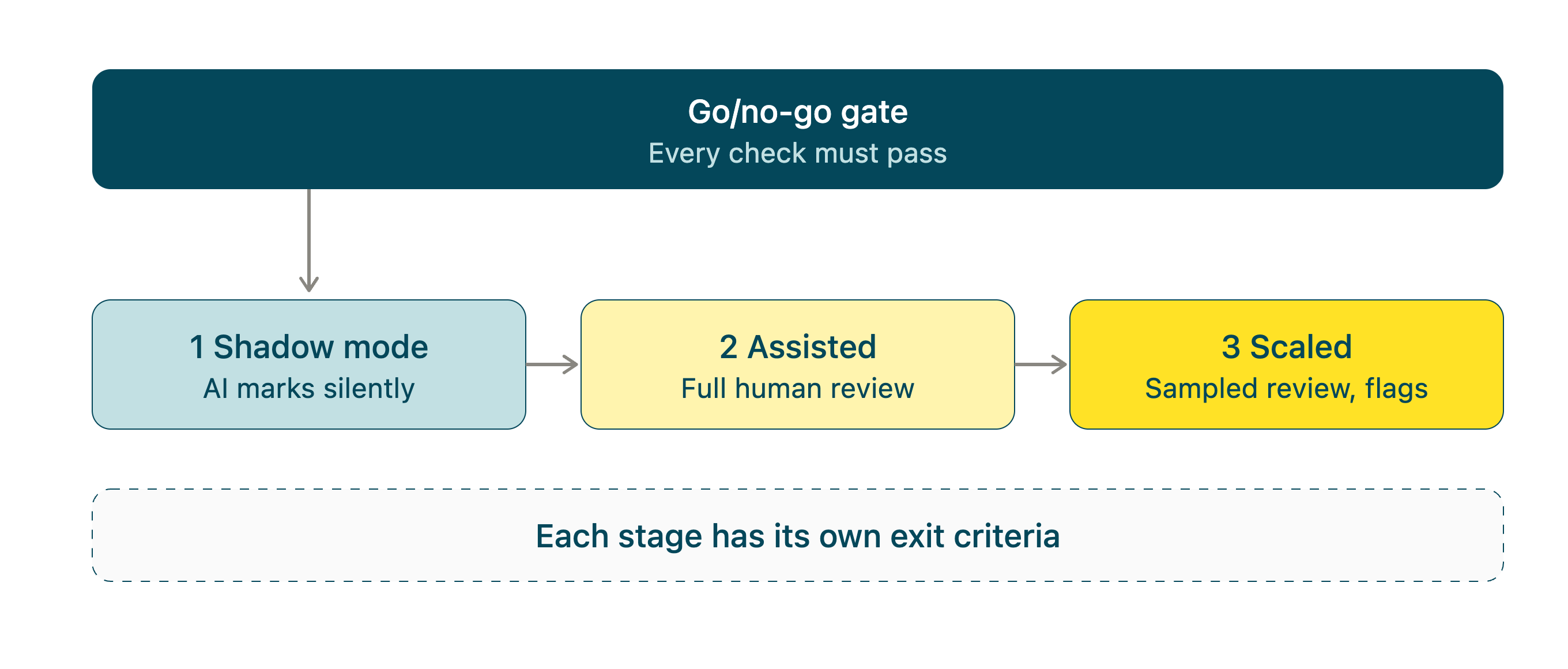
Before scaling, there is a gate, and every check has to pass:
- Thresholds met on blind data
- Fairness checks passed
- Audit trail in place
- Human sign-off workflow tested
- A named accountable owner
- A fallback process if the AI is switched off
- Regulatory mapping completed
Rollout is then staged, so evidence builds before reliance does. The diagram below shows the gate and the three stages.
Red Flags: Signs AI Use Is Ungoverned
If the practices above are the standard, these are the warning signs:
- Using AI in silos: assessors paste learner work into public chatbots on their own, with no policy and no oversight.
- No audit trails: there is no record of how a score or piece of feedback was produced, so it can’t be defended.
- Over-reliance on AI: a human is technically in the loop but approves without really checking.
- Unvalidated AI: scores and feedback reach learners without being validated against experts first.
- No post-deployment monitoring: nobody tracks drift, bias or agreement with experts once the tool is live.
Three Questions to Ask Any Vendor
Always remember to ask the difficult questions:
- Which kind of AI is it, what data was it trained on, and why is it right for this task?
- Where is the expert in the loop, and how are accuracy and consistency proven?
- How is quality monitored and maintained once it is live?
Final Thoughts
AI-assisted assessment can raise consistency and free up expert time. But it only earns a place in high-stakes decisions when you can show the data, the validation, the limits and the monitoring.
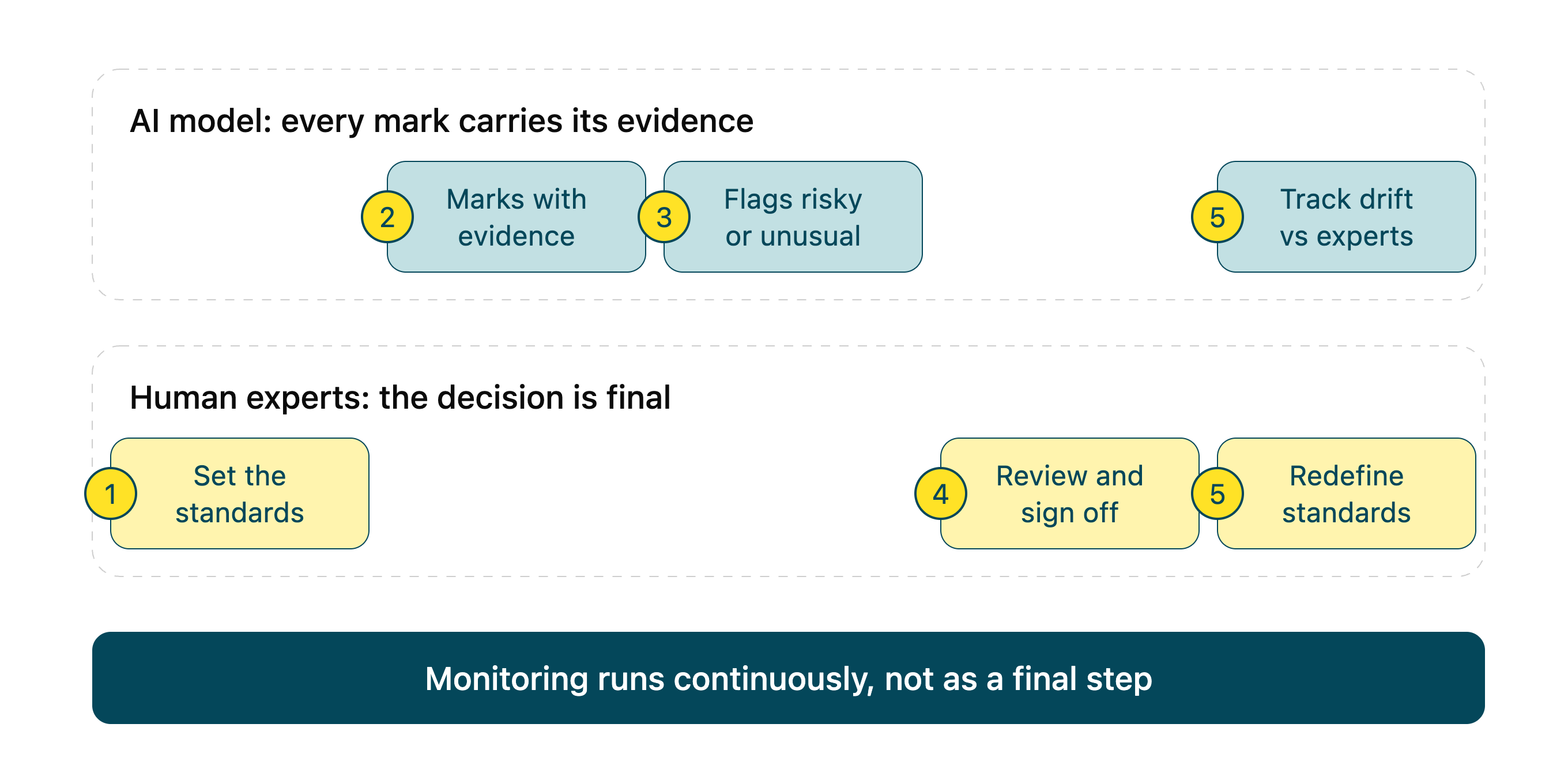
At Sainaptic, our approach keeps experts in control, with:
- Evidence behind every AI mark
- Validation against your own best markers
- Limits that are found, documented and routed to humans
- Monitoring that continues long after go-live
If you’d like to see what this looks like in practice, Book a Demo.